Farley's raid footage
Inherent ViceFarley’s raid footage is a 16-mm film of the armed raid at the Channel View development, made by Farley Branch and later screened for Doc Sportello. It captures the masked force surrounding Chick Planet Massage and, with devastating clarity, the killing of Glen Charlock. The reel transforms Doc’s uncertain recollection of the assault into evidence he can inspect, but the camera’s limitations mean that seeing the raid does not mean identifying who carried it out.
Origin and Recovery
Farley had spent years documenting environmental damage across the United States, including the cleared land and construction at Channel View Estates. A veteran of the Signal Corps, he had acquired an old, army-green Bell & Howell 16-mm camera, a spring-wound machine dating from World War II. He had been at Channel View on the day of the vigilante raid, filming it; after the footage went to a laboratory, he waited to get it back.
When Spike tells Doc that Farley has recovered the film, the recording becomes a way back into an episode Doc cannot fully understand from his own experience. Doc goes with Spike to Farley’s place, where the film is already threaded onto a projector. The return from lab to projector matters: the film is no longer merely a roll of captured images but a replayable record that others can examine together.
The Raid on Screen
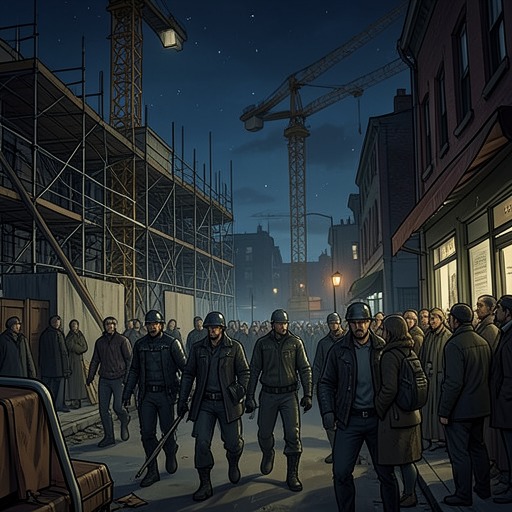
The footage opens on a sunny view of half-built ranch-style development and construction hardpan. Into this ordinary-looking landscape come men in matching camouflage fatigues and ski masks, carrying a varied stock of heavy weapons. The camera records the raiders splashing across a flood-control channel, securing street and footbridges, and forming a perimeter around the temporary mini-plaza whose principal tenant is Chick Planet Massage.
Doc spots his own car outside the building. The motorcycles that had been there when he arrived are gone, while the film shows Mickey Wolfmann’s armed group riding away through the tract, seemingly uncertain of its mission. This perspective gives Doc a strange relation to the images: he is watching a place where he had been, and where, during the assault, he lay unconscious inside. The footage makes the past externally visible while emphasizing how much of the event he could not witness at the time.
Glen Charlock’s Death and the Image
The film records Glen Charlock, unarmed, moving in a guarded crouch before one of the masked gunmen shoots him. The camera’s view makes the contrast plain: Glen’s attempt to appear tough cannot conceal his fear, and the bright daylight offers no protection. The shooter proceeds methodically, taking aim and firing short bursts; the recording shows Glen’s death as an act rather than leaving it as an uncertain report.
That clarity gives the footage its most consequential evidentiary force. It confirms the circumstances of Glen’s death and exposes the violence at the center of the raid, but it does not provide a clear identification of the gunman. The image can show what happened without answering who was behind the mask—a distinction that shapes Doc’s next question.
A Limited Record
The screening itself is fragmented. Farley’s camera holds only a hundred feet of film before the reel must be changed, so the coverage jumps. Its three turret lenses—long, normal, and wide-angle—can be rotated during a shot, further marking the footage as a mechanically mediated view rather than a continuous, neutral account. The film is silent, yet Doc experiences the images as if he can hear the action. His response registers the force of the record without turning it into a complete reconstruction.
Doc asks whether the laboratory can make an extra print or enlarge frames to reveal what is behind the masks. Farley warns that enlargement will destroy much of the image resolution, though he agrees it can be tried. The exchange sets a boundary around what the footage can prove: it records the raid and Glen’s killing with unusual directness, but the faces that might establish responsibility remain obscured, and the available image may not bear the scrutiny Doc needs.
Evidence, Surveillance, and Mediation
The footage belongs to a wider world in which images and files make private actions newly visible. Earlier, Doc glimpses a federal file containing a telephoto photograph of himself in a parking lot, taken while he examines a hamburger. Later, information about Shasta Fay Hepworth’s arrival at Los Angeles International Airport circulates through the ARPAnet, and the FBI’s interest in her becomes apparent to Fritz. These different records—government photograph, network information, and Farley’s celluloid film—each extend what can be known about a person or event, but none is the same as complete understanding.
That limit becomes explicit when Sparky explains that the system does not absorb people’s souls; it finds things someone did not expect others to discover. Knowledge and surveillance are accelerating, he says, even though the technology remains clumsy compared with the speed and capacity imagined in spy films and television. Farley’s footage embodies that tension in material form: it makes an unseen killing available for repeated inspection, yet its brief reels, shifting lenses, silence, and indistinct masks preserve gaps that no replay can automatically close. The film is therefore both a witness to the raid and a reminder that recorded visibility is not the same as certainty.